Already a subscriber? Make sure to log into your account before viewing this content. You can access your account by hitting the “login” button on the top right corner. Still unable to see the content after signing in? Make sure your card on file is up-to-date.
A Tibetan man died after setting himself on fire outside the United Nations headquarters in New York.
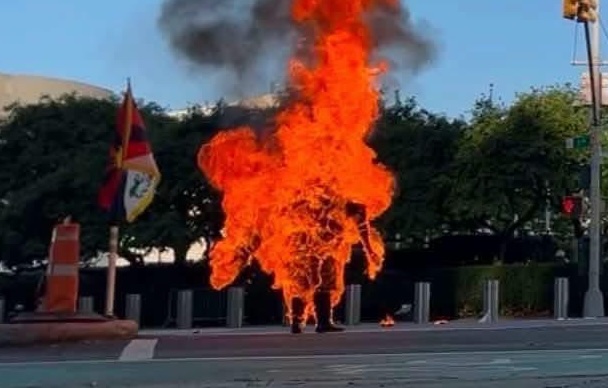
Getting into it: The incident occurred on Thursday when Lobga Rangzen, an Uber driver who had lived in the US for years, went to First Avenue opposite the UN carrying a Tibetan flag and set himself on fire. Cops got a 911 call around 6:30 p.m. and found him badly burned. Medics rushed him to Bellevue Hospital, where he later died.
Activists and exiled Tibetan media identified the man as Rangzen, and Voice of Tibet said he “self-immolated outside the U.N. headquarters in New York after a live appeal for Tibetan independence and unity.”

A video streamed from a Facebook account showed him holding the flag along First Avenue before he was engulfed in flames, collapsing as cars passed until two men doused the fire with extinguishers. In a separate video, he called on Tibetans to unite for “the independence of Tibet” and accused the Chinese government of policies “aimed at destroying the Tibetan identity, culture and language.” Police recovered fliers he scattered, one reading “CHINA OUT OF TIBET.”

China, which has governed Tibet since the early 1950s, describes its takeover as a “peaceful liberation” while insisting the region has been Chinese territory for centuries. Many Tibetans reject that, saying China is trying to stamp out their language, religion and cultural identity.
The death comes days after China enacted an ethnic unity law on July 1 that tightens rules on the use of Chinese in schools and government offices across minority regions and calls for deeper religious “Sinicization.” The US and European Union have raised concerns about the law, which aims to forge one “shared” national identity spanning all 55 of the country’s ethnic minority groups.
China rejects criticism of its rule in Tibet and treats any sign of alleged “separatism” among minorities as a highly sensitive matter.
Related posts:
 Updates From Middle East
 Annual US Threat Assessment Again Identifies China as Largest Threat to US National Security, Warns of Growing Military Power
 Pentagon-Affiliated Think Tank Warns of China’s Growing Presence in Africa, Cites Concerns Over Potential Military Use of 231 Commercial Ports
 A Deep Dive: Influencers and “Independent” Journalists on Both Sides Being Paid to Advance Political Talking Points