Already a subscriber? Make sure to log into your account before viewing this content. You can access your account by hitting the “login” button on the top right corner. Still unable to see the content after signing in? Make sure your card on file is up-to-date.
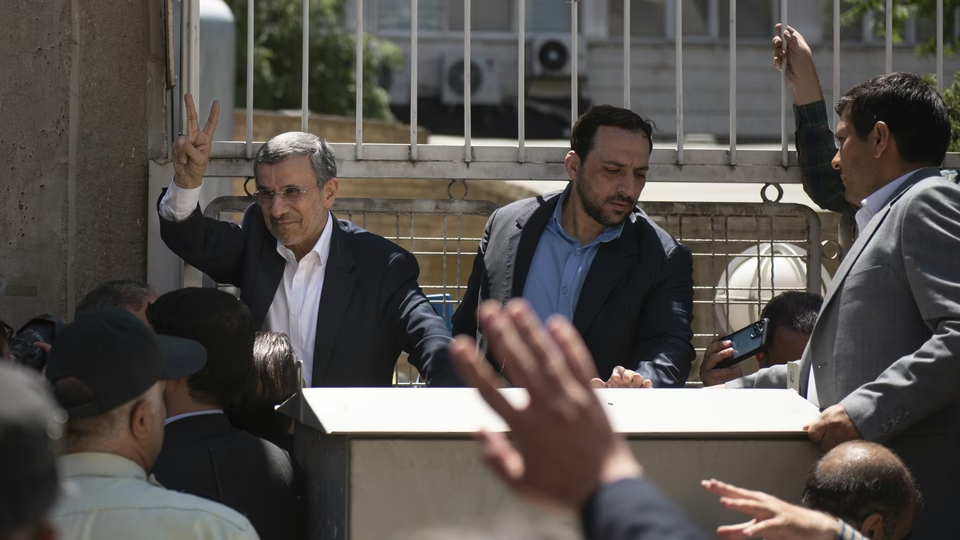
According to an explosive report by the New York Times, US and Israeli officials were seeking to install former hardline President Mahmoud Ahmadinejad as Iran’s new leader during the war, before the plan quickly fell apart.
Some shit you should know before you dig in: If you’re unaware, former Iranian President Mahmoud Ahmadinejad served as the country’s president from 2005 to 2013 and was one of the most infamous figures in Iran’s political elite. During his presidency he became globally known for his calls to “wipe Israel off the map,” his denial of the Holocaust, his fierce anti-American rhetoric, his staunch support for Iran’s nuclear program, and his violent crackdowns on internal dissent, along with a string of announcements (including his claim that there was not a single gay person in Iran). In the years after leaving office, however, Ahmadinejad gradually recast himself as a critic of the theocratic establishment, falling out badly with Supreme Leader Ayatollah Ali Khamenei, repeatedly hammering senior Iranian officials over corruption and bad governance, and getting himself arrested in 2018 after criticizing his successor’s government. Iran’s Guardian Council blocked him from running for president three separate times (in 2017, 2021, and 2024), his aides were arrested and tortured, and the regime, increasingly wary of him, kept him largely confined to his house and treated him as a threat to its own stability.

What’s going on now: First reported by NYT, the US and Israel had a plot to topple Iran’s theocratic government, and Ahmadinejad himself had reportedly been consulted about it before the war even began. The plan hinged on a single move on the war’s opening day**, February 28**: while the US and Israel killed Supreme Leader Ayatollah Ali Khamenei in a strike on his Tehran compound that morning, an Israeli airstrike simultaneously hit a security outpost outside Ahmadinejad’s home in the Narmak neighborhood of eastern Tehran, killing three Islamic Revolutionary Guard Corps members who were pulling double duty as his bodyguards and his house-arrest jailers.
According to US officials, that strike was deliberately designed as a “jailbreak operation” to free Ahmadinejad from house arrest so he could step in and seize power. Ahmadinejad survived (initial Iranian reports that he had been killed were later corrected), and an associate confirmed to the Times that Ahmadinejad read the strike as a move to spring him loose, and that Washington saw him as capable of handling “Iran’s political, social and military situation.”
The plan unraveled almost immediately, however, because the near-miss spooked Ahmadinejad himself. US officials say that after surviving the strike on his home, Ahmadinejad soured on the whole regime-change scheme and pulled the plug on his cooperation. He’s dropped out of public view entirely since the early days of the war, and nobody knows where he is or what shape he’s in.
The broader Israeli blueprint had reportedly mapped out the war in distinct stages: air assaults and the killing of Iran’s top leadership, followed by influence campaigns and a mobilization of Kurdish fighters to create internal instability and a feeling that the regime was losing its grip, ultimately leading to its total collapse and the installation of what the Israelis called an “alternative government.” In practice, almost nothing beyond the initial air campaign and the killing of Khamenei played out as planned, with the operation badly underestimating how durable Iran would prove and how little the US and Israel could actually force on the ground.
Another view: The White House pushed back on the report and reiterated that its stated war aims were narrowly focused on Iran’s military capabilities. “From the outset, President Trump was clear about his goals for Operation Epic Fury: destroy Iran’s ballistic missiles, dismantle their production facilities, sink their navy, and weaken their proxy,” White House spokeswoman Anna Kelly said. “The United States military met or exceeded all of its objectives, and now, our negotiators are working to make a deal that would end Iran’s nuclear capabilities for good.”
Iranian state media wasn’t buying any of it, casting heavy doubt on the report and flatly rejecting the idea that Ahmadinejad had ever been under house arrest at all.
Related posts:
 Updates From Middle East
 A Deep Dive: Influencers and “Independent” Journalists on Both Sides Being Paid to Advance Political Talking Points
 Annual US Threat Assessment Says Russia Has ‘Upper Hand’ in Ukraine, Circumvents Sanctions via China & BRICS Nations
 Global Leaders React to Assassination Attempt on Trump