Already a subscriber? Make sure to log into your account before viewing this content. You can access your account by hitting the “login” button on the top right corner. Still unable to see the content after signing in? Make sure your card on file is up-to-date.
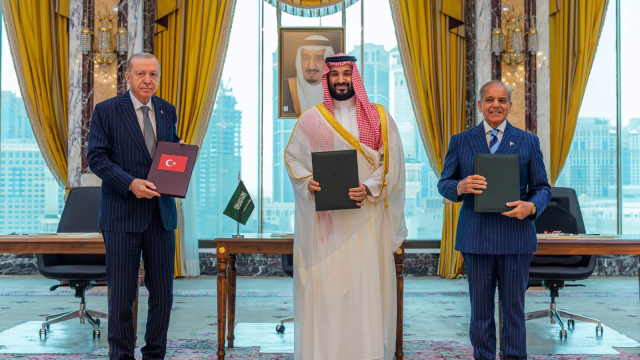
Saudi Arabia, Turkey, and Pakistan signed a joint defense agreement that guarantees that an armed attack on any one of them will be treated as an attack on all three.
Getting into it: The Mecca Joint Defense Agreement was signed Friday by Crown Prince Mohammed bin Salman, President Recep Tayyip Erdogan, and Prime Minister Shehbaz Sharif after nearly a year of negotiations. The text has not been made public, and the joint statement gives no specifics on what any party is actually obligated to do. It says the pact is “intended to strengthen collective deterrence against any act of aggression” and “further provides for the enhancement of all aspects of defense cooperation among the three States.”

The pact has raised some eyebrows because Saudi Arabia has been a target of Iran since the United States and Israel attacked Iran on Feb. 28. Missiles from Iran and its allies have been landing on the kingdom and across the Gulf, and energy shipments out of the region have been choked off. Houthi rebels in Yemen have also attempted to cut the kingdom off by sea and gone after its oil infrastructure, its airports, and tankers moving through the Red Sea. A spokesman for the Saudi-led coalition in Yemen said Friday that shelling the day before had wounded 11 civilians in southern Yemen, one of them a Pakistani national.
Each country signing the pact brings something different to the table. Turkey has the second-largest army in NATO and a weapons industry that keeps growing. Pakistan is the lone Muslim state with nuclear weapons, and it already has roughly 8,000 troops sitting in the kingdom along with jets, drones, and air defense. Saudi Arabia brings the money and the coastlines.
Despite all of this, everyone involved in the pact says that this does not single out a specific country or rebel group. In a statement, Saudi Deputy minister Rayed Krimly wrote, “The agreement does not represent any intention to build a military axis or a sectarian/religious bloc.” Erdogan said it reaffirms the right of defense under Article 51 of the UN Charter and is “open to the participation of all brotherly countries.” Sharif called it a “shield of peace.”
This all comes as Iran has downplayed the pact, with lawmaker Ebrahim Rezaei posting that “a paper agreement with Turkiye and Pakistan will not bring them security, just as years of one-sided nursing to the Americans did not bring them security,” and telling Saudi Arabia to “reform your policies so that you do not need to beg for security from others.”
Related posts:
 Updates From Middle East
 Pakistan Deploys Fighter Jets to Saudi Arabia Under Mutual Defense Pact
 Trump Defends Pakistan’s Role as Mediator After Top Republican Lawmaker Demands New Mediator Over Pakistan Harboring Iranian Warplanes from US Strikes
 US Agrees to Sell F-35’s to Saudi Arabia, Israel Pissed