Already a subscriber? Make sure to log into your account before viewing this content. You can access your account by hitting the “login” button on the top right corner. Still unable to see the content after signing in? Make sure your card on file is up-to-date.
Japan’s space agency successfully launched and landed a reusable rocket for the first time, joining the exclusive club of countries chasing the cost-slashing technology SpaceX has dominated for a decade.
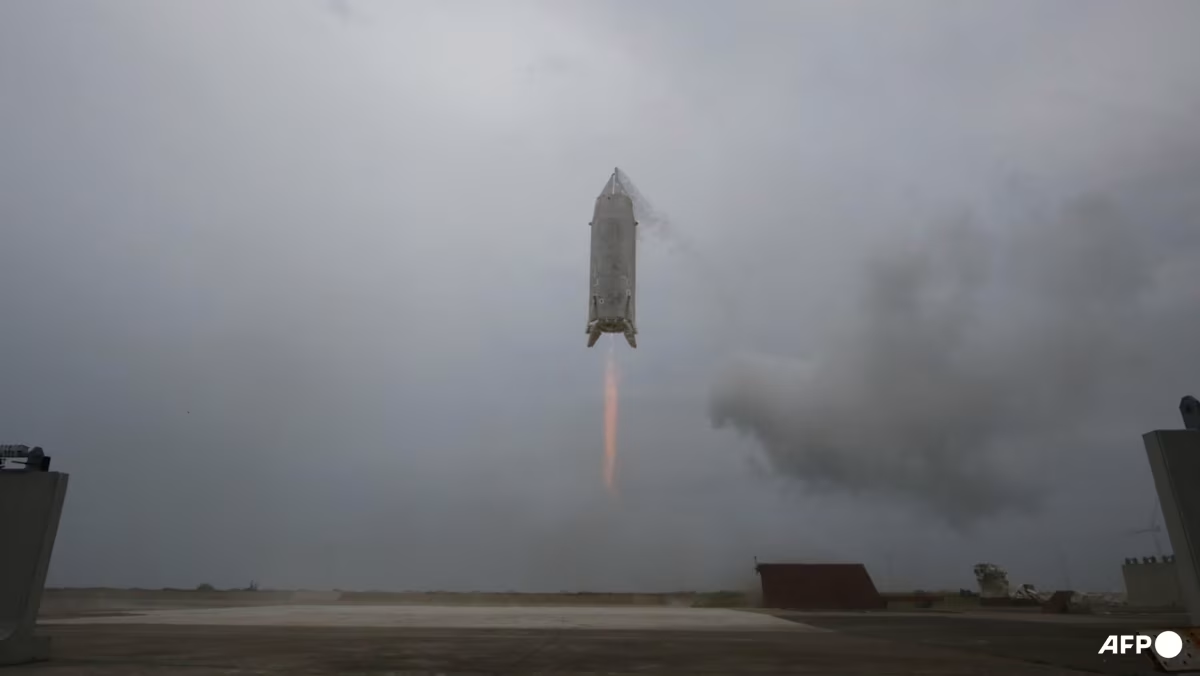
Getting into it: The announcement came from the Japan Aerospace Exploration Agency on Saturday after its RV-X prototype flew at the Noshiro Testing Center in northeastern Japan. The rocket rose off the pad, held a brief hover, and shifted sideways without tipping over before touching down on its four shock-absorbing legs, with JAXA reporting it reached roughly 10 to 11 meters in height and traveled about 16 meters. From liftoff to touchdown, the entire test took around 40 seconds.

“I feel we have put a great deal of time and effort into this, and now that the prototype has taken off and landed without problem, I must say I feel a great sense of relief,” said Takashi Ito, JAXA’s reusable rocket project manager, adding that while the agency will review the data to fully determine the test’s success, he’s “confident” it “obtained very useful data.”
For those unfamiliar, the vast majority of rockets get thrown away after one flight. Their parts either splash down in the ocean, disintegrate on reentry, or stay in orbit as junk, and the priciest piece of the whole vehicle is the first stage. Reusable rockets change the economics entirely, recovering and reflying the same booster to make launch operations run more like an airline. SpaceX got there first, sticking the landing of an orbital-class booster back in December 2015, and its Falcon 9 workhorse now launches roughly every two days, with one booster recently completing a record 36th flight.
The RV-X, co-developed with Mitsubishi Heavy Industries, is 1.8 meters in diameter and 7.3 meters long, powered by an engine that has withstood 165 combustion tests. The agency isn’t going it alone either, partnering with France and Germany on reusable rocket development, and the next round of RV-X tests will aim for around 100 meters up.
The timing is notable as just one day earlier, China pulled off its own milestone, recovering a booster from an orbital-class rocket for the first time.
Related posts:
 Updates From Middle East
 A Deep Dive: Influencers and “Independent” Journalists on Both Sides Being Paid to Advance Political Talking Points
 US Navy Partners with Start-up Company to Develop Advanced Rocket Engines
 Israel Renews Strikes in Lebanon, Vows to Maintain Permanent Military Presence in Gaza Until All Hostages Are Released