Already a subscriber? Make sure to log into your account before viewing this content. You can access your account by hitting the “login” button on the top right corner. Still unable to see the content after signing in? Make sure your card on file is up-to-date.
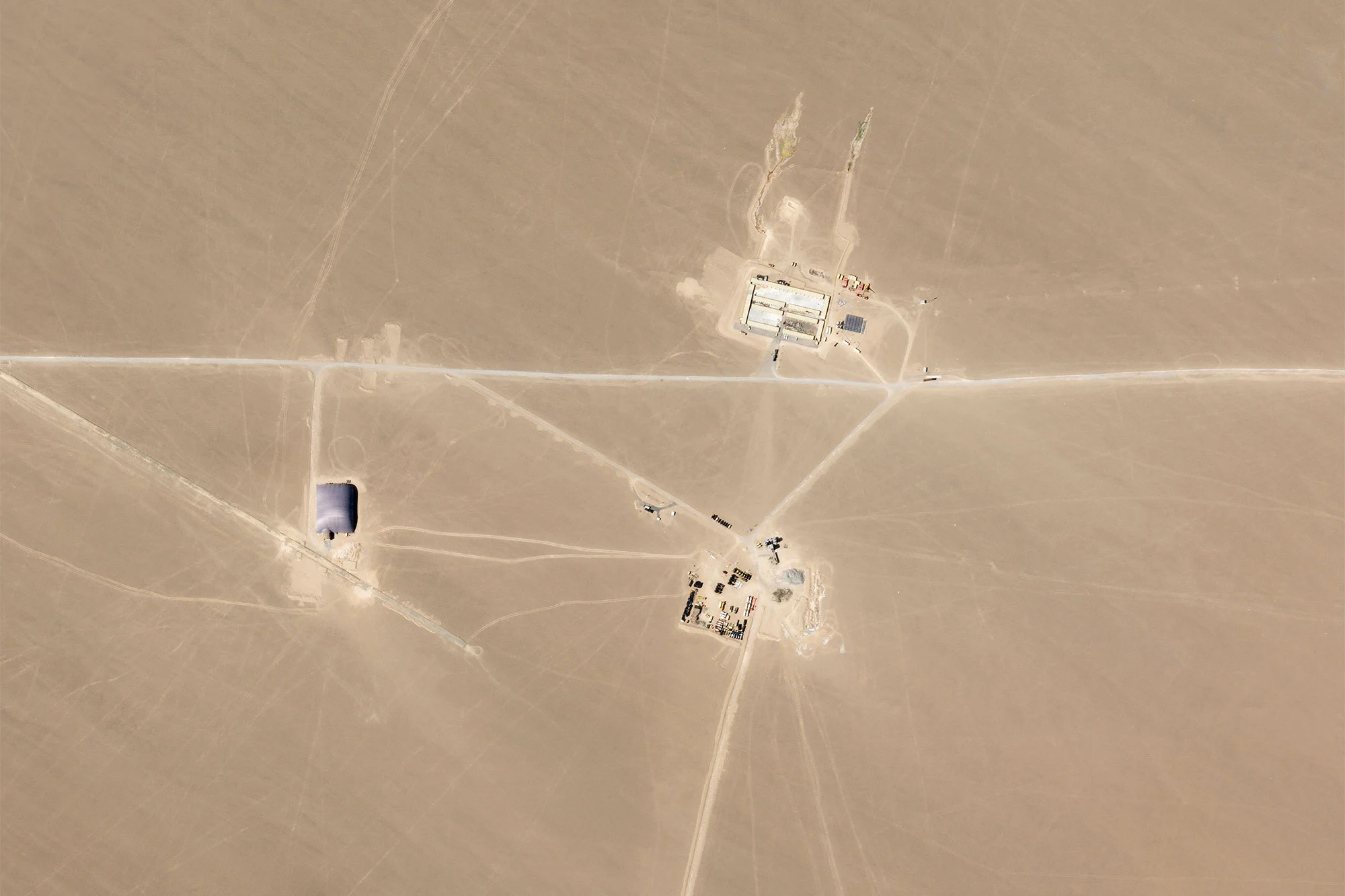
Satellite images reviewed by Reuters reveal that China is constructing a sprawling military complex in a remote desert to protect its nuclear arsenal and ensure it could retaliate against any US first strike.
Getting into it: The previously unreported network, located in the northwestern Xinjiang region near the silos housing China’s longest-range missiles, includes more than 80 launch pads along with bunkers and communications nodes. Analysts say it could field mobile missile launchers, air-defense batteries, and electronic-warfare operations.

At the heart of the build-out sit two octagon-shaped installations that came together over the last six years, both lying southwest of the Hami silo fields at roughly 140 and 230 kilometers out. The imagery shows armored bunkers and weapons storage, plus airfields and rail links connecting them to the silos, with recent images revealing military exercises and concealed launch positions carved into the desert floor. A third octagon near the Lop Nur nuclear test site is the least finished of the three and seems to double as a firing range, scattered with what analysts say are Western fighter jets.
The construction fits a broader picture of rapid nuclear expansion. US officials say China is growing its arsenal more aggressively than any other country, with the Pentagon projecting Beijing will have 1,000 warheads by 2030 and estimating it has already loaded about 100 intercontinental ballistic missiles across its silo fields.
China has also bolstered an early-warning satellite system capable of detecting an incoming missile within 90 seconds, giving it time to launch a response. While Beijing maintains a “no first use” doctrine and casts its weapons as purely defensive, some Western analysts fear it could resort to nuclear coercion to keep outsiders out of a Taiwan conflict. This kind of layered protection may be what separates China from the US and Russia, which lean more on the raw count of their silos than on heavy missile defense.
This all comes as tensions over Taiwan between the US and China are high, with Xi Jinping warning Trump last month that mishandling the dispute could lead to a “dangerous place.”
Related posts:
 Updates From Middle East
 Top US Official Accuses China of Rapidly Expanding Nuclear Arsenal, Comes After Claims China Tested a Nuclear Weapon
 Annual US Threat Assessment Again Identifies China as Largest Threat to US National Security, Warns of Growing Military Power
 Pentagon-Affiliated Think Tank Warns of China’s Growing Presence in Africa, Cites Concerns Over Potential Military Use of 231 Commercial Ports