Already a subscriber? Make sure to log into your account before viewing this content. You can access your account by hitting the “login” button on the top right corner. Still unable to see the content after signing in? Make sure your card on file is up-to-date.
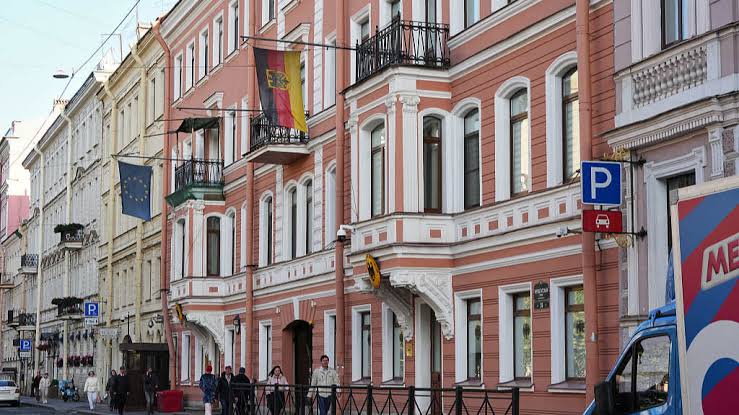
Russia’s Foreign Ministry has ordered Germany’s Consulate-General in St. Petersburg to shut down by Sept. 18 in retaliation for Berlin closing the Russian consulate in Bonn.
Getting into it: This all started after Russia was accused of an attempted drone attack on Leipzig/Halle Airport on Aug. 4, after an explosive device was discovered on a drone sitting near a Ukrainian aircraft at a major freight hub used to move support into Ukraine. The drone was defused, and German intelligence services concluded Moscow was behind it. Last week, Germany announced the closure of the Bonn consulate and the Russian House cultural center in Berlin, a longtime symbol of postwar relations. Germany also said it would tighten entry rules for Russian citizens.
Russia has denied involvement and called the allegation “an absurd fabrication.” Russian President Vladimir Putin gave no specifics but said the evidence against Russia had been “planted.” Russia first responded by ordering all Goethe-Institut branches closed, with staff out of the country by Sept. 13, then followed Monday with the consulate order.

Russian Foreign Minister Sergei Lavrov said, “In general, this is, broadly speaking, kind of the beginning of a real war. I remember that before the start of World War II, the Great Patriotic War, the Germans also closed their diplomatic missions. They want war again.” He accused Chancellor Friedrich Merz of “moving to declare war on us,” and said Russia’s leadership “will draw the appropriate conclusions.”
Merz responded, saying, “I will not budge a single millimeter from my fundamental conviction that we must defend our freedom against Russia as well.”
This all comes as Germany has seen other sabotage attempts targeting its power grid and defense contractors over the past two weeks. European officials have described Russia’s hybrid campaign as one of the bloc’s most significant strategic threats, a characterization Moscow rejects.
Related posts:
 Updates From Middle East
 Germany Blames Russia for Failed Drone Attack on Ukrainian Cargo Plane
 Annual US Threat Assessment Says Russia Has ‘Upper Hand’ in Ukraine, Circumvents Sanctions via China & BRICS Nations
 A Deep Dive: Influencers and “Independent” Journalists on Both Sides Being Paid to Advance Political Talking Points