Already a subscriber? Make sure to log into your account before viewing this content. You can access your account by hitting the “login” button on the top right corner. Still unable to see the content after signing in? Make sure your card on file is up-to-date.
Germany has formally blamed Russia for an attempted drone attack on a Ukrainian cargo plane at Leipzig/Halle Airport last month, closing a Russian consulate and raising its national threat level in response.
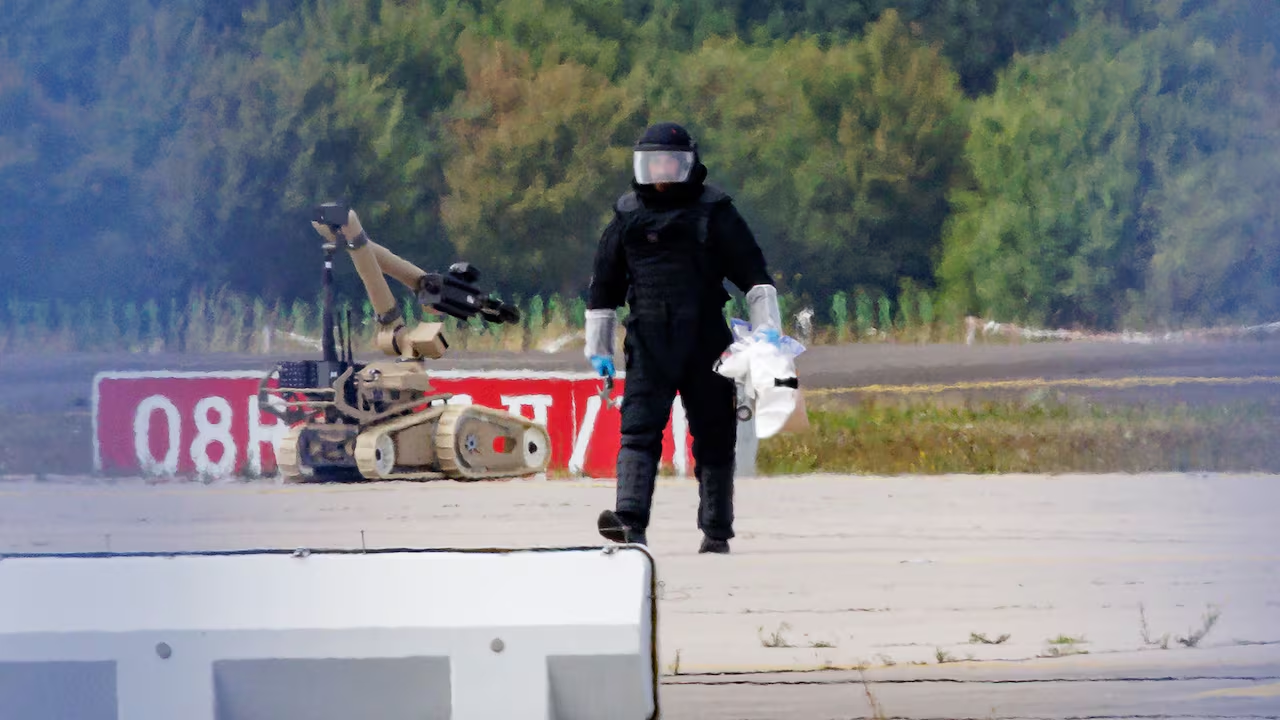
Some shit you should know before you dig in: Leipzig/Halle is one of Europe’s busiest cargo airports and a critical part of the Ukraine supply chain, with Antonov Airlines operating there since Russia destroyed its original hub in 2022 and NATO running its Strategic Airlift International Solution from the same airport with near-daily resupply flights. European intelligence agencies have spent years tracking suspected Russian sabotage across the continent, including arson, hacking, GPS jamming, drones, explosives on Polish rail lines carrying aid to Ukraine, and attacks on undersea cables. In August, an airport worker found a drone carrying military-grade explosives after its detonator failed. Footage from the airport showed it slamming into the wing of a massive Ukrainian cargo jet. A second drone hit another cargo plane approaching the airport, and a third explosive-laden drone was found in a nearby field about 10 days later.

What’s going on now: In a notable development, the German government said investigators can prove the people flying the drone were operating “on behalf of Russian state entities.” Interior Minister Alexander Dobrindt made the announcement at a Berlin press conference alongside Foreign Minister Johann Wadephul, saying the attack lines up with how Russian hybrid operations have run in Europe for years and that Germany should assume it will be targeted again.
He also raised Germany’s threat assessment from “general” to “high,” adding, “We are not at war, but we are a daily target of hybrid attacks.”
Wadephul summoned the Russian ambassador and ordered the closure of Moscow’s consulate general in Bonn along with the Russian House cultural center in Berlin, which observers have long described as a front for espionage and propaganda. Germany is also tightening entry controls on Russians and will push the EU for more sanctions, travel restrictions, and tougher action against Russia’s shadow fleet. “There is no overreaction on our part, but there is a response when we are attacked,” Wadephul said. “Russia must understand that Germany is a stabilizing force in Europe, one that is always ready to negotiate but will not be intimidated in any way.”

Despite all of this, Russia is denying everything. Putin, speaking at the Shanghai Cooperation Organization summit in Bishkek, suggested the evidence was fabricated to prop up a weak government, saying Chancellor Friedrich Merz “has lost the trust of citizens because he is not protecting Germany’s national interests” and calling Berlin’s response a serious mistake.
Foreign ministry spokeswoman Maria Zakharova said Russia will answer the “anti-Russian action,” adding, “The Russian House has long haunted them. That’s why they were looking for something to latch onto.”
Western allies lined up behind Germany. NATO Secretary-General Mark Rutte said that “the evidence is clear” and that “Russia’s attempts to intimidate us, to undermine our unity and our willingness to support Ukraine are futile and will fail.” European Commission President Ursula von der Leyen said EU foreign ministers, meeting in Ireland Tuesday evening, would prepare a response including additional sanctions. French Foreign Minister Jean-Noel Barrot said there would “inevitably be consequences” if the gravity of the events was confirmed.
This all comes as the incidents keep stacking up, with Poland opening a terror investigation Monday into a fire at a factory making parts for drones bound for Ukraine.
Related posts:
 Updates From Middle East
 Annual US Threat Assessment Says Russia Has ‘Upper Hand’ in Ukraine, Circumvents Sanctions via China & BRICS Nations
 Ukraine Hits Three Russian Oil Tankers, a Warship, and a Patrol Boat in Coordinated Drone Strikes
 Russia and Ukraine Agree to Partial Ceasefire Agreement in Black Sea & on Energy Infrastructure