Already a subscriber? Make sure to log into your account before viewing this content. You can access your account by hitting the “login” button on the top right corner. Still unable to see the content after signing in? Make sure your card on file is up-to-date.
Federal regulators have cleared Amazon’s Zoox to start charging passengers for rides in robotaxis that have no steering wheel, no pedals, and no driver’s seat, something no company has been allowed to do before.
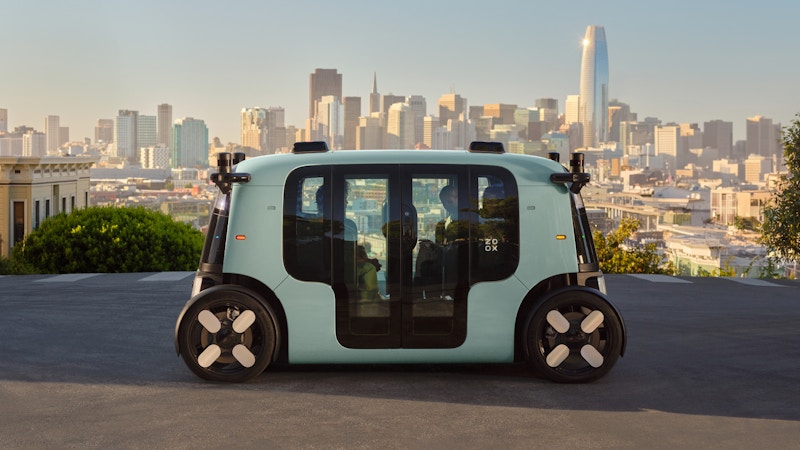
Some shit you should know before you dig in: If you’re unaware, Amazon operates a fleet of driverless vehicles through Zoox, a self-driving startup it bought for $1.2 billion. These are not modified cars. The vehicles are squared-off pods built to look more like a shuttle than a sedan, seating four passengers who face one another, and they top out at 75 miles per hour with nothing inside that a person could grab to steer or brake. That is why the approval took so long. Federal motor vehicle safety standards were written decades ago on the assumption that a person would be steering. Waymo, the industry leader, sidestepped the problem entirely by using retrofitted Jaguar SUVs that still have wheels and pedals.

What’s going on now: The National Highway Traffic Safety Administration granted Zoox a temporary exemption Thursday from the rules requiring human controls, letting it deploy up to 2,500 vehicles per year for two years. Paid rides start in Las Vegas next month, and the company has said it will expand into other cities once it satisfies the individual state rules governing commercial service.
NHTSA Administrator Jonathan Morrison framed the decision as conditional rather than settled. “We can say pretty clearly that the systems in place on the Zoox exceed the equivalent performance requirements of a compliant vehicle,” he said. “But we still want to make sure that the automated driving system will operate appropriately.”

The agency is also imposing conditions beyond the approval itself. Zoox has to file additional reports when its vehicles crash or park themselves somewhere they shouldn’t in live traffic, keep every remote operator inside the US, and publish maps showing the areas its fleet covers. “We have the ability to pull the exemption if we see major safety issues,” Morrison said.
In a statement, Zoox CEO Aicha Evans said, “We are honored to receive the first-ever commercial exemption for a purpose-built robotaxi from NHTSA, enabling us to begin charging for our service and take another step toward bringing autonomous ride-hailing to more communities.”
This all comes as there’s growing concern that these vehicles will put millions of people who drive for a living out of work. Estimates put the number of rideshare drivers in the US somewhere between 1.5 and 2 million across Uber and Lyft. Uber alone reported 1 million American drivers the last time it disclosed a number. Layer in taxi and chauffeur work, delivery, and the broader for-hire transportation sector, and the exposure runs even higher.
Despite this, the industry argues that robotaxi fleets create their own jobs in remote operations, maintenance, cleaning, and depot work, and that Zoox is capped at 2,500 vehicles a year under this exemption.
Related posts:
 Updates From Middle East
 Trump Signs Executive Order Requiring Commercial Truck Drivers to Speak English
 A Deep Dive: Influencers and “Independent” Journalists on Both Sides Being Paid to Advance Political Talking Points
 US Rolls Back Rules on Self-Driving Vehicles in Effort to Counter Chinese Car Companies