Already a subscriber? Make sure to log into your account before viewing this content. You can access your account by hitting the “login” button on the top right corner. Still unable to see the content after signing in? Make sure your card on file is up-to-date.
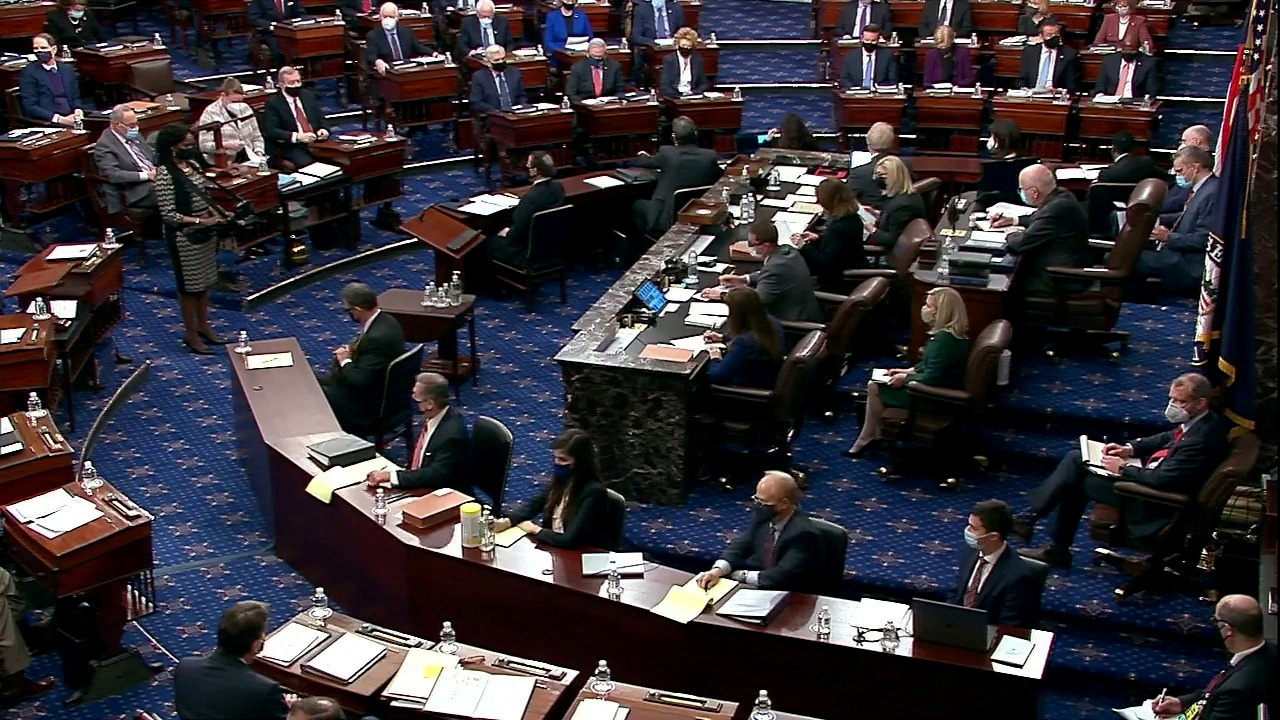
The US Senate voted Tuesday to advance a War Powers Resolution that would require President Donald Trump to wind down the war in Iran unless Congress authorizes it to continue.
Some shit you should know before you dig in: If you’re unaware, the US and Israel launched their war against Iran in late February, and roughly 80 days into the conflict, it remains locked in a fragile ceasefire while continuing to drive up global oil prices and gas prices at home. The War Powers Resolution of 1973, which Congress passed back in the Vietnam era, caps a president’s ability to run military operations at 60 days, after which he has to either shut it down, get Congress to sign off, or ask for a 30-day extension. Back on May 1, Trump claimed a ceasefire with Iran had “terminated” hostilities, the logic being that he’d never actually crossed the 60-day line. Despite that position, US troops have continued to blockade Iranian ports and attack Iranian shipping while Iran’s forces continue to block access to the Strait of Hormuz and have attacked US vessels. The White House has simultaneously argued both that it has technically ceased “hostilities” because of the ceasefire and that it rejects the entire 1973 War Powers law as unconstitutional. Democrats have forced repeated votes on war powers resolutions throughout the conflict, but Senate Republicans have successfully blocked all seven previous attempts this year (and narrowly defeated three similar resolutions in the House).

What’s going on now: In a notable development, the Senate voted 50-47 on Tuesday to advance the resolution, with four Republicans breaking ranks to side with nearly every Democrat in the chamber, getting the measure over the line for the first time after seven straight failures. The four Republicans were Rand Paul of Kentucky, Susan Collins of Maine, and Lisa Murkowski of Alaska (all of whom had supported similar resolutions before), plus Bill Cassidy of Louisiana, who supported a war powers resolution for the first time just days after losing his Republican primary to a Trump-endorsed challenger.
Cassidy framed his switch around the administration’s lack of transparency on the war. “While I support the administration’s efforts to dismantle Iran’s nuclear program, the White House and Pentagon have left Congress in the dark on Operation Epic Fury. In Louisiana, I’ve heard from people, including President Trump’s supporters, who are concerned about this war. Until the administration provides clarity, no congressional authorization or extension can be justified.”
Pennsylvania’s John Fetterman was once again the only Democrat to vote no, and three Republicans skipped the vote entirely: John Cornyn of Texas, Thom Tillis of North Carolina, and Tommy Tuberville of Alabama. Had all three shown up and voted against it, the tally would have deadlocked at 50-50 and the measure would have died.
The resolution, introduced by Sen. Tim Kaine (D-VA), would formally direct the president to “remove the United States Armed Forces from hostilities within or against Iran, unless explicitly authorized by a declaration of war or a specific authorization for use of military force.” Senate Minority Leader Chuck Schumer framed the vote as evidence of cracking Republican support for the war. “Vote by vote, Democrats are breaking through Republicans’ wall of silence on Trump’s illegal war. For more than 80 days, Trump has dragged America into a costly, chaotic conflict with no plan, no objective, and no legal authority. Today proved our pressure is working: Republicans are starting to crack, and momentum is building to check him.”
Even with the breakthrough, the resolution has a long road ahead before it actually means anything. Should it clear the full Senate, it then has to get past a House that Republicans control (which is expected to vote on a similar resolution Wednesday, after one fell short there last week and ended in a tie), and from there it would have to survive a Trump veto that’s all but guaranteed, which would mean rounding up two-thirds majorities in both chambers.
This all comes as Trump announced Monday that the US would not follow through with what he called “scheduled” attacks on Iran on Tuesday (though he noted he had been “an hour away” from ordering new strikes before calling them off to give Gulf allies more time to broker an agreement).