Already a subscriber? Make sure to log into your account before viewing this content. You can access your account by hitting the “login” button on the top right corner. Still unable to see the content after signing in? Make sure your card on file is up-to-date.
The Senate is set to vote on a war powers resolution that aims to curtail President Trump’s authority to initiate further military action in Venezuela without congressional approval.
Some shit you should know before you dig in: Just to bring you up to speed, the Trump administration maintains that its actions in Venezuela are justified and do not require prior congressional approval because they were framed as law enforcement and counterterrorism operations, not a traditional war. Officials point to Nicolás Maduro being a wanted fugitive facing US indictments for narcoterrorism and drug trafficking, and note the US does not recognize his government as legitimate. The administration also designated the Cartel de los Soles as a Foreign Terrorist Organization, allowing it to liken these actions to longstanding US operations against groups like ISIS and other terrorist organizations.

What’s going on now: The resolution, brought forward by Senate Minority Leader Chuck Schumer (D-NY) and Senator Rand Paul (R-KY), seeks to require President Trump to come to Congress for authorization before taking additional military action in the South American nation. The measure advanced last week with the backing of five Senate Republicans, and the Senate is headed toward a vote Wednesday on the resolution after US troops captured Venezuelan leader Nicolás Maduro in a surprise nighttime raid earlier this month.
Secretary of State Marco Rubio responded to concerns from senators about the president’s war powers in a one-page letter to Senate Foreign Relations Committee Chair Jim Risch (R-ID), stating plainly, “There are currently no US Armed Forces in Venezuela.” Rubio added that “should there be any new military operations that introduce US Armed Forces into hostilities, they will be undertaken consistent with the Constitution of the United States and we will transmit written notifications consistent with section 4(a) of the War Powers Resolution (Public Law 93-148).” Rubio added that the US was not going to put ground troops in Venezuela.
The vote has taken on heightened political significance, with Republican leaders working to sink the bipartisan measure and public pressure from President Trump, who has lashed out at GOP senators who joined Democrats to advance the resolution, raising doubts about whether the measure will ultimately pass.
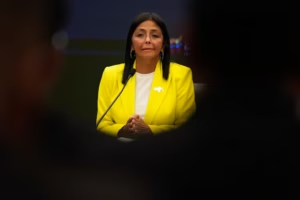
This comes as acting Venezuelan President Delcy Rodríguez, who took over after Maduro’s ouster, has described her government as entering a “new political era,” seeking to balance US demands without alienating Maduro loyalists who still control security forces and intelligence services.