Already a subscriber? Make sure to log into your account before viewing this content. You can access your account by hitting the “login” button on the top right corner. Still unable to see the content after signing in? Make sure your card on file is up-to-date.
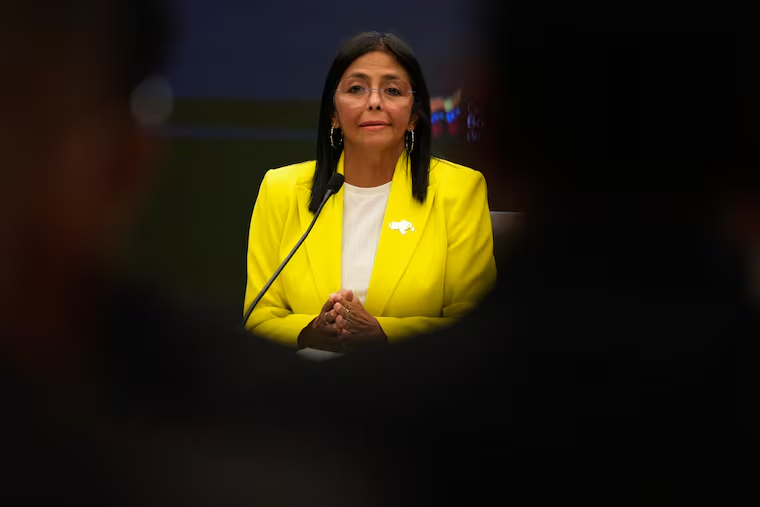
Venezuela’s Supreme Court has officially ordered Vice President Delcy Rodríguez to assume the role of acting president following the capture of Nicolás Maduro by the United States.
Getting into it: The order came down shortly after US forces detained Maduro, with Venezuela’s Supreme Court citing the need to ensure “administrative continuity and the comprehensive defense of the Nation.” The court ruled that Vice President Delcy Rodríguez would temporarily assume the powers of the presidency during what it described as the “forced absence” of Maduro, while it considers a longer term legal framework to preserve state authority and sovereignty.

Rodríguez is one of the most powerful and loyal figures in Venezuela’s ruling system, having served for years as Maduro’s vice president, foreign minister, and oil minister. She has been among his fiercest defenders internationally and is closely aligned with the inner circle that has governed since Hugo Chávez’s era. In her first speeches after assuming the role, Rodríguez made clear that her appointment did not represent a break with Maduro but rather a continuation of his authority. “There is only one president in Venezuela and his name is Nicolás Maduro,” she said, framing her role as temporary and defensive rather than transitional.
In her first remarks following Maduro’s capture, Rodríguez condemned the US operation as a “brutal aggression” and an “atrocity that violates international law,” demanding the immediate release of Maduro and his wife. She accused the United States of pursuing regime change under false pretenses, saying, “The masks have fallen off, revealing only one objective: regime change in Venezuela,” which she argued would allow the seizure of the country’s “energy, mineral and natural resources.” While she said she was willing to have “respectful relations” with Washington, she stressed that this would only be possible after the US accounted for what she described as an unlawful attack on Venezuelan sovereignty.
Initially, there were signs of limited engagement between Rodríguez and the US, including a phone call with Marco Rubio that appeared, at least briefly, to open a channel of communication. That tone has since deteriorated. Rubio has publicly stated that Rodríguez is not Venezuela’s legitimate leader and that the current governing structure lacks democratic legitimacy, instead calling for a transition period followed by real elections.
This all comes as US officials, including President Trump, have said the United States intends to “run” Venezuela until the country is ready for a peaceful transition, though few concrete details have been offered about what that governance would look like in practice.