Already a subscriber? Make sure to log into your account before viewing this content. You can access your account by hitting the “login” button on the top right corner. Still unable to see the content after signing in? Make sure your card on file is up-to-date.
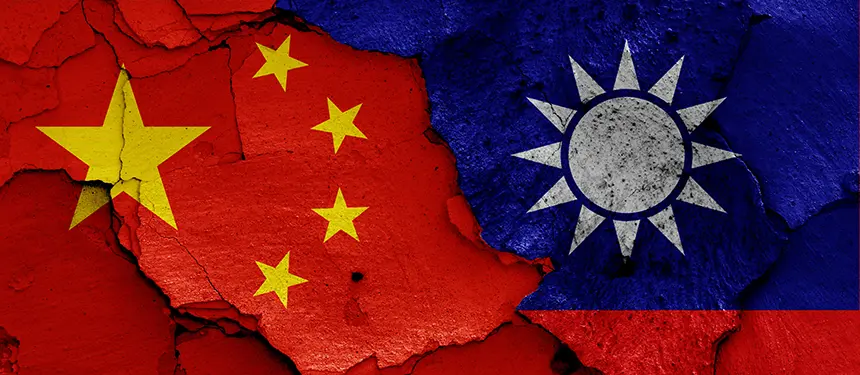
China has carried out a large-scale military drill around Taiwan in response to the United States approving its largest-ever arms sale to Taiwan.
Some shit you should know before you dig in: If you’re unaware, the United States recently approved a massive $11.1 billion arms sale to Taiwan, the largest in the island’s history. The package includes $4 billion for 82 High-Mobility Artillery Rocket Systems (HIMARS), another $4 billion for 60 self-propelled howitzers, and $3 billion worth of Javelin anti-tank missiles, helicopter components, tactical mission software, and refurbishment kits for Harpoon anti-ship missiles. This deal still requires approval by the US Congress, but it’s already being viewed as a significant escalation in US-Taiwan military cooperation, effectively integrating Taiwan’s defense system more deeply with America’s.

What’s going on now: Both China and Taiwan confirmed that the Chinese military launched large-scale, multi-branch military drills around Taiwan, a show of force Beijing called Justice Mission 2025. The exercises, which began Monday, spanned the Taiwan Strait and waters and airspace to the island’s north, southwest, southeast, and east. According to China’s Eastern Theater Command, the drills involved coordinated operations by PLA ground forces, navy, air force, rocket troops, and unmanned aerial vehicles. These included sea-air combat patrols, precision strikes on land-based mobile targets, simulated blockades, and deterrence activities beyond the island chain, a reference to the Pacific defense perimeter.
Senior Colonel Shi Yi, spokesperson for the Eastern Theater Command, said the drills were “a stern warning against ‘Taiwan independence’ separatist forces and external interference forces” and described them as “a legitimate and necessary action to safeguard China’s sovereignty and national unity.” PLA analysts echoed the hardline stance, with Major General Meng Xiangqing adding that “the PLA has plenty of strategic options to punish independence forces in Taiwan and to deter the U.S. — and they can turn the exercise into a war at any time.” Fu Zhengnan, a researcher at the PLA Academy of Military Science, claimed the US-Taiwan military relationship is becoming so tight that Taiwan’s defense system is now effectively “a natural extension” of America’s, heightening the risk of direct conflict.
Taiwan’s Ministry of National Defense responded by placing its forces on high alert and launching rapid response exercises to counter the PLA’s moves. It condemned China’s drills as “irrational provocations” that threaten regional stability. Taiwan’s National Security Council Secretary-General Joseph Wu called the Chinese military action “an act of escalation,” and insisted, “We remain resolute and unafraid. We’ll defend our sovereignty and democracy at all times.” Taiwan’s Civil Aviation Administration also warned that the live-fire drills would affect more than 100,000 international travelers, with over 850 international and 80 domestic flights canceled or diverted.
The United States has not issued an official statement on the drills yet.
Related posts:
 Updates From Middle East
 Annual US Threat Assessment Again Identifies China as Largest Threat to US National Security, Warns of Growing Military Power
 China Condemns US Decision to Sell $11.1 Billion in Weapons to Taiwan, Says US Will End Up “Harming Itself”
 Pentagon-Affiliated Think Tank Warns of China’s Growing Presence in Africa, Cites Concerns Over Potential Military Use of 231 Commercial Ports