Already a subscriber? Make sure to log into your account before viewing this content. You can access your account by hitting the “login” button on the top right corner. Still unable to see the content after signing in? Make sure your card on file is up-to-date.
President Trump is demanding that a group of Arab and Muslim-majority nations normalize relations with Israel by joining the Abraham Accords as a condition of any deal to end the war with Iran.
Some shit you should know before you dig in: If you’re unaware, the Abraham Accords are a series of US-brokered agreements first signed in September 2020 during Trump’s first term, designed to normalize diplomatic, economic, and security relations between Israel and Arab and Muslim-majority nations that had historically refused to recognize the Jewish state. The United Arab Emirates and Bahrain were the original signatories, with Morocco, Sudan, and eventually Kazakhstan coming aboard later. The core reason many countries in the region have long withheld recognition of Israel comes down to the Palestinian issue, with most Arab and Muslim states conditioning any normalization on the creation of an independent Palestinian state and an end to Israeli occupation of Palestinian territory. Saudi Arabia, for instance, has maintained that it will only recognize Israel if there is an “irreversible pathway” to Palestinian statehood, while Pakistan has flatly refused to do so until Palestinians get a state of their own.

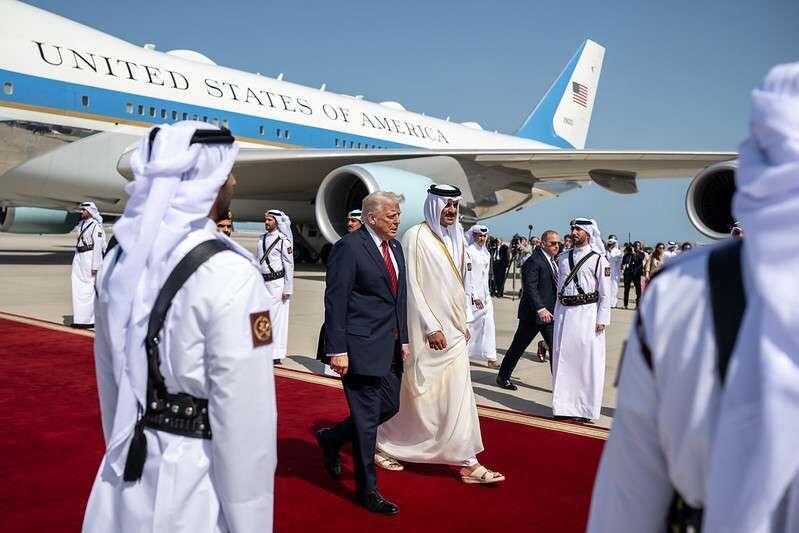
What’s going on now: In a lengthy Truth Social post on Monday, Trump said that after all the US work to broker an Iran settlement, “it should be mandatory that all of these Countries, at a minimum, simultaneously, sign onto the Abraham Accords.” Trump specified he wanted Saudi Arabia, Qatar, Pakistan, Turkey, Egypt, and Jordan to sign on, with Saudi Arabia and Qatar going “immediately” and “everybody else” following suit. He framed it as a loyalty test tied directly to the Iran deal, warning that countries that refuse “should not be part of this Deal in that it shows bad intention,” though he allowed that “one or two” might have a reason to decline. Trump said he had tasked envoys Steve Witkoff and Jared Kushner with completing the process.
The demand came after Trump reportedly raised it on a weekend call with the leaders of those nations. According to Axios, “there was silence on the line and Trump joked and asked if they are still there.” Trump went even further, floating the idea that Iran itself could eventually join the accords once a deal is signed. “If Iran signs its Agreement with me… it would be an Honor to have them also be part of this unparalleled World Coalition.”
This all comes as US-Iran negotiations, mediated by Pakistan, continue into the war’s third month. The reported framework kicks off with a 60-day ceasefire extension and reopens the Strait of Hormuz, buying time to hash out Iran’s nuclear program and sanctions relief down the road. Trump said the talks were “proceeding nicely” but repeated his standard threat that it would be “a Great Deal for all or, no Deal at all — Back to the Battlefront.”
Republicans have torn into the framework, likening it to the Obama-era nuclear deal. That set Trump off on the lawmakers he has branded disloyal, including Sens. Thom Tillis and Bill Cassidy, and Rep. Thomas Massie, who he dismissed as people who don’t “know anything about the potential deal I am making with Iran.”
Secretary of State Marco Rubio defended the emerging agreement, calling it “absurd” to suggest Trump would ever accept a deal that leaves Iran stronger, while Sen. Lindsey Graham (himself a skeptic of the Iran terms) praised the Abraham Accords expansion as “simply brilliant” and potentially “the most significant change in the Middle East in thousands of years.”
Related posts:
 Updates From Middle East
 Hamas Reviewing Trump’s 20-Point Ceasefire Agreement Backed by Israel & Multiple Arab States
Arab Leaders Propose $53 Billion Gaza Reconstruction Plan, US & Israel Reject Plan
Hamas Reviewing Trump’s 20-Point Ceasefire Agreement Backed by Israel & Multiple Arab States
Arab Leaders Propose $53 Billion Gaza Reconstruction Plan, US & Israel Reject Plan
 Top US Official Says United States No Longer Pursuing Two-State Solution Between Israel & Palestine