Already a subscriber? Make sure to log into your account before viewing this content. You can access your account by hitting the “login” button on the top right corner. Still unable to see the content after signing in? Make sure your card on file is up-to-date.
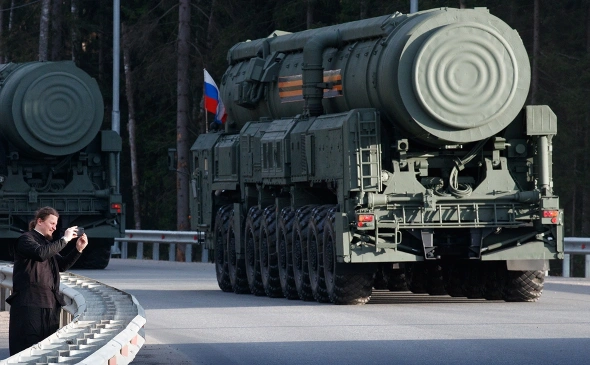
Belarus announced Monday that it has launched joint drills with Russia to practice the operational deployment and use of the Russian tactical nuclear weapons currently stationed on Belarusian soil.
Some shit you should know before you dig in: If you’re unaware, Russia first deployed some of its tactical nuclear weapons to Belarus in 2023 following a direct request from Belarusian President Alexander Lukashenko. Russia also confirmed last December that its newer Oreshnik system, an intermediate-range platform capable of carrying nuclear warheads, was now operational on Belarusian soil. Notably, Belarus borders Ukraine and three full NATO members in Poland, Latvia, and Lithuania. The Kremlin rewrote its formal nuclear doctrine in 2024 to extend Russian nuclear protection directly to Belarus, with Putin stating publicly that command authority over the weapons stays in Russian hands but Minsk would get to pick what gets hit if a real conflict ever kicks off. Putin has separately bragged that Oreshnik carries multiple warheads capable of hitting Mach 10 on terminal descent, is functionally immune to existing Western interceptors, and could deliver damage on par with a tactical nuke even when loaded with conventional payloads (the conventional variant has already been fired into Ukrainian territory twice, hitting targets in November 2024 and again this past January).

What’s going on now: The Belarusian Defense Ministry announced the new joint exercises in a Monday statement, framing them as a scheduled training event involving both missile units and warplanes that is not directed at any third country and does not pose a security threat to the broader region. The stated purpose of the drills is specifically to test the Belarusian and Russian militaries’ joint readiness to deploy nuclear weapons from unprepared areas across different parts of the country. The Russian Defense Ministry had not yet released its own statement on the joint exercises at the time of publication.
Ukraine’s Foreign Ministry condemned the drills and urged its Western allies to tighten existing sanctions against both Russia and Belarus. “By turning Belarus into its nuclear staging ground near NATO borders, the Kremlin is de facto legitimizing the proliferation of nuclear weapons worldwide and setting a dangerous precedent for other authoritarian regimes. Such actions must face unequivocal and resolute condemnation from all states that respect the nuclear non-proliferation regime.”
Belarusian opposition leader Sviatlana Tsikhanouskaya (who has been operating in exile since being forced out of the country during the 2020 election crackdown) criticized the drills in a statement to the Associated Press, arguing that the Russian nuclear deployment was making Belarus less safe rather than more. “Lukashenko has turned Belarus into a platform for Russian threats, but Belarusians don’t need these weapons. Only a free Belarus will become a source of security, not nuclear blackmail, in Europe.”
This all comes as Ukrainian President Volodymyr Zelenskyy warned Friday (citing Ukrainian intelligence reports) that Russia was actively considering using Belarusian territory to either mount a fresh invasion of northern Ukraine or stage an attack on one of the three NATO countries bordering Belarus (Latvia, Lithuania, or Poland).
Kremlin spokesman Dmitry Peskov rejected Zelenskyy’s allegation Monday and accused the Ukrainian president of trying to escalate the war. “Such a statement is nothing other than an attempt at further incitement aimed at prolonging the war and escalating tensions.”
Related posts:
 Updates From Middle East
 Annual US Threat Assessment Says Russia Has ‘Upper Hand’ in Ukraine, Circumvents Sanctions via China & BRICS Nations
 Top Belarusian Official Says Upcoming Military Drills with Russia Will Include Simulated Nuclear Strikes and Russia’s New “Oreshnik” Missile
 Russia Announces Nuclear-Capable Hypersonic Missiles Placed on Combat Duty in Belarus