Already a subscriber? Make sure to log into your account before viewing this content. You can access your account by hitting the “login” button on the top right corner. Still unable to see the content after signing in? Make sure your card on file is up-to-date.
The European Union, United Kingdom, and Canada rolled out coordinated sanctions Monday against Russian officials, state institutions, and youth camps tied to the forced removal and ideological re-education of Ukrainian children.
Some shit you should know before you dig in: Roughly 20,500 Ukrainian children have ended up in Russia or Russian-occupied parts of eastern Ukraine since the full-scale invasion kicked off in early 2022. Once there, a lot of them lose their Ukrainian identity entirely and are handed Russian passports, placed with Russian adoptive families, shipped off to ideological “re-education” camps, or pushed into military training programs designed to turn them into soldiers against their own country. Moscow doesn’t deny any of this, but Russian officials argue they’re protecting the kids by pulling them out of combat zones, and say they’ll send them back once relatives show up and prove who they are. Ukraine has accused Russia of “kidnapping” these children. The International Criminal Court hit Russian President Vladimir Putin with an arrest warrant in 2023, charging him with the war crime of unlawfully removing kids from Ukraine.
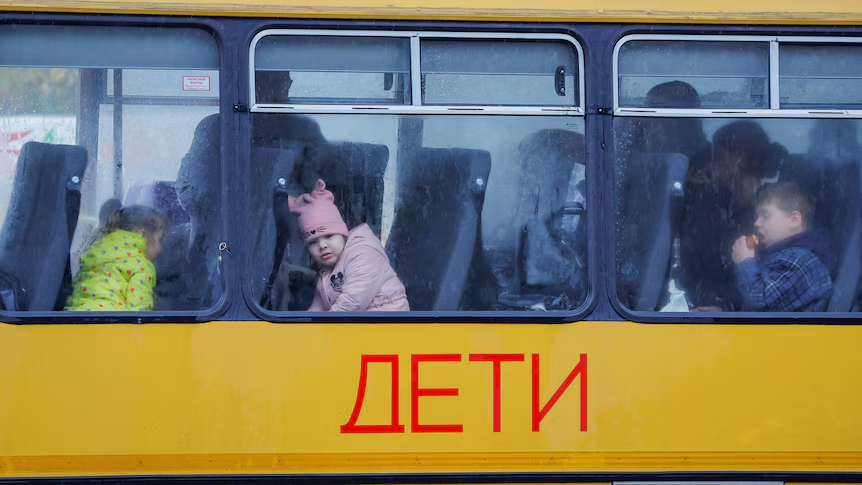
What’s going on now: In a notable development, the three rounds of sanctions were announced Monday targeting officials, institutions, and camps tied to Russia’s deportation and “indoctrination” of Ukrainian children, alongside the third high-level meeting of the International Coalition for the Return of Ukrainian Children. The EU package targeted 16 individuals and seven entities, the UK package was the broadest with 85 people and entities (roughly a third tied directly to the child-abduction campaign), and Canada sanctioned 23 individuals and five organizations.
The EU’s sanctions specifically targeted officials and institutions running camps and educational programs where Ukrainian children are subjected to pro-Russian indoctrination and militarized training. Among those named was Lilya Shvetsova, who runs the “Red Carnation” camp in Russian-occupied Crimea, along with several federal facilities tied to Russia’s Ministry of Education, including the All-Russian Children’s Centres Orlyonok, Scarlet Sails, and Smena. Those three work hand in hand with occupation authorities to run programs that put Ukrainian kids through “patriotic events, ideological education, and military-oriented activities.”
Other sanctioned institutions included the DOSAAF Centre in Sevastopol, the Nakhimov Naval School, and the Military-Patriotic Club “Patriot” in Crimea, all of which the EU said are involved in “the re-education, ideological indoctrination, and militarisation of minors, fostering loyalty to Russia and undermining Ukrainian national identity.” The UK additionally named the Centre for Military and Patriotic Training and Education of Youth (referred to as the “warrior centre”), a Russian state institution where Ukrainian children are reportedly subjected to military training and pro-Kremlin ideology, along with Yulia Sergeevna Velichko, the Moscow-installed minister for youth policy in the so-called “Luhansk People’s Republic.”
The UK’s broader sanctions list also went after Russia’s information warfare machine. That included 49 staffers at the Social Design Agency, a Kremlin-funded outfit accused of running disinfo and meddling operations. Some of that work has reportedly focused on setting up pro-Russia groups inside Armenia and trying to tilt the country’s upcoming elections.
In a statement, the EU’s top diplomat, Kaja Kallas, said “Stealing children is not incidental. It is a deliberate Russian policy, a calculated attack on Ukraine’s future.” Latvian Foreign Minister Baiba Braže went further at the EU ministers meeting and explicitly tied the campaign to the legal definition of genocide. “Russia is trying to erase their identity. When you look at the Genocide Convention, it’s one of the features of the genocide crime. So, it’s very serious.”
As of now, there’s been no comment from Russia.
Related posts:
 Melania Trump Confirms Talks with Putin on Releasing Ukrainian Children Taken During War
 Senate to Move Forward with Bill Designating Russia as State Sponsor of Terrorism
 Annual US Threat Assessment Says Russia Has ‘Upper Hand’ in Ukraine, Circumvents Sanctions via China & BRICS Nations
 US Announces New Sanctions Targeting Russia’s Military-Industrial Complex, Kremlin Pissed