Already a subscriber? Make sure to log into your account before viewing this content. You can access your account by hitting the “login” button on the top right corner. Still unable to see the content after signing in? Make sure your card on file is up-to-date.
The United States and Iran are moving forward with direct talks aimed at de-escalating rising tensions between the two countries.
Some shit you should know before you dig in: If you’re unaware, the United States is currently moving military assets into the Middle East in a show of force aimed at Iran. In the last two weeks, the US aircraft carrier USS Abraham Lincoln arrived in the region, with US defense officials confirming its presence as part of a broader strategic deployment. Trump has confirmed that Iran needs to make a “deal” to avert the US taking military action against its country. While Trump hasn’t been clear about what a “deal” would entail, he has acknowledged that any agreement would have to revolve around Iran’s nuclear program.
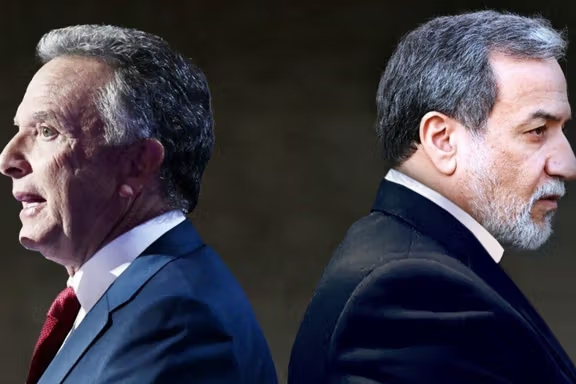
What’s going on now: In a notable development, the US has confirmed that communication lines with Iran have opened, and both sides will hold direct talks. The proposed negotiations, which will take place in Turkey, are being facilitated by regional powers including the Turkish government, Egypt, and Qatar, who are attempting to broker a diplomatic off-ramp amid growing fears of conflict. US special envoy Steve Witkoff will lead the American delegation, while Iranian officials, including Foreign Minister Abbas Araghchi and Supreme National Security Council head Ali Larijani, are engaged in laying the groundwork for discussions. Talks will reportedly focus on Iran’s nuclear program, with the US demanding strict limits on uranium enrichment and the reinstatement of international inspections.
On the US side, President Trump has repeatedly said that Iran must agree to a deal that ensures “no nuclear weapons,” stating that negotiations are serious and not a diversion from potential military action. He’s warned that failure to reach an agreement could lead to a military strike, citing the deployment of “very big, powerful ships” near Iran. The Trump administration has also raised concerns about Iran’s ballistic missile program and its backing of proxy groups in the region, suggesting these could become sticking points in the negotiations, even if they are not part of the initial agenda.
Iran, meanwhile, insists that any talks must be conducted without threats or preconditions. Araghchi has clearly rejected including Iran’s missile program or its regional military posture in the discussions, stating, “Let’s not talk about impossible things.” He added that Iran distrusts the US due to past betrayals, but also voiced optimism about reaching a “fair and equitable deal” focused solely on the nuclear issue.