Already a subscriber? Make sure to log into your account before viewing this content. You can access your account by hitting the “login” button on the top right corner. Still unable to see the content after signing in? Make sure your card on file is up-to-date.
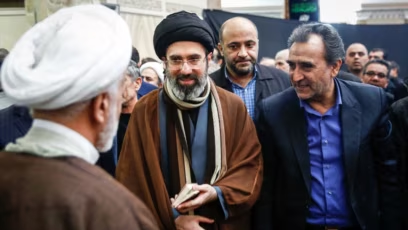
According to an Iranian news outlet, the country’s Assembly of Experts has appointed Mojtaba Khamenei, the son of the assassinated Supreme Leader Ali Khamenei, as Iran’s next supreme leader.
Getting into it: According to Iran International, the Assembly of Experts (a clerical body responsible for selecting Iran’s supreme leader) voted to promote Mojtaba Khamenei to the position following the death of his father in Israeli airstrikes. The report, citing informed sources, claimed the decision was made under pressure from Iran’s powerful Islamic Revolutionary Guard Corps, which backed Mojtaba as the most suitable figure to lead the country during a major security crisis. The Assembly of Experts consists of 88 senior Shiite clerics who are elected but vetted by the regime, and under Iran’s constitution they hold the authority to appoint, supervise, and even dismiss the supreme leader. If confirmed, Mojtaba would become only the third person to hold the role since the Islamic Republic was established in 1979.
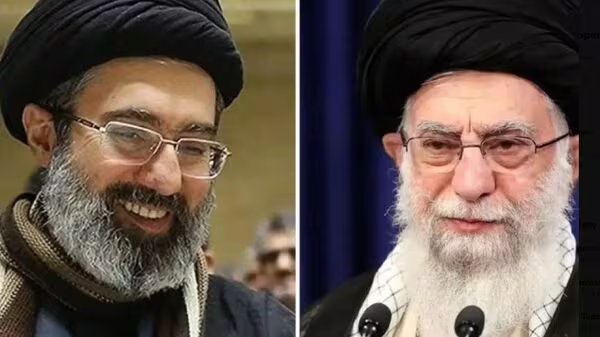
Conflicting reports: Other reports from US-based outlets have been more cautious, saying the clerical body is still deliberating and that Mojtaba Khamenei has emerged as the leading contender rather than the confirmed successor. Those reports say members of the assembly have been holding meetings (some reportedly virtual) while considering a shortlist of candidates drafted by a smaller internal committee.
The deliberations were also overshadowed by an Israeli airstrike in the city of Qom, one of the most important centers of Shiite religious authority. Israeli officials said the strike targeted a building where the Assembly of Experts was expected to meet to finalize the leadership decision. An Israeli defense official said the goal was to disrupt the process of appointing a new supreme leader, though Iranian media later reported that the building was empty at the time of the strike.
This all comes as many believe that if chosen as Supreme Leader, Mojtaba would likely continue and possibly intensify his father’s confrontational stance toward the United States and Israel while relying heavily on the security and military apparatus to maintain control.
While Mojtaba has emerged as the front-runner, several other clerics have also been discussed as possible successors. Among them are Alireza Arafi, a senior cleric and jurist who is part of a temporary leadership council, and Seyed Hassan Khomeini, the grandson of the Islamic Republic’s founding leader Ayatollah Ruhollah Khomeini. Both are generally viewed as more moderate figures.
Related posts:
 Updates From Middle East
 Putin Publicly Condemns Assassination of Ayatollah Ali Khamenei, Other Countries React
 Iran’s Leader Releases New Statements Following Ceasefire with Israel, Claims Victory & Says Iran’s Nuclear Program Wasn’t Completely Destroyed
Iran Says It Won’t Stop Enriching Uranium, Doesn’t Need “Green Light from America”
Iran’s Leader Releases New Statements Following Ceasefire with Israel, Claims Victory & Says Iran’s Nuclear Program Wasn’t Completely Destroyed
Iran Says It Won’t Stop Enriching Uranium, Doesn’t Need “Green Light from America”