Already a subscriber? Make sure to log into your account before viewing this content. You can access your account by hitting the “login” button on the top right corner. Still unable to see the content after signing in? Make sure your card on file is up-to-date.
A confrontation between Chinese and Philippine vessels in the South China Sea has left a Filipino sailor injured, with both countries blaming each other.
Some shit you should know before you dig in: If you’re unaware, China and the Philippines have beef over overlapping territorial claims in the South China Sea. The Philippines says it has sovereign rights over areas within its Exclusive Economic Zone, including places like the Scarborough Shoal and parts of the Spratly Islands, based on the United Nations Convention on the Law of the Sea and a 2016 international tribunal ruling that threw out Beijing’s sweeping claims to the waterway. China has refused to recognize that ruling and has continued to claim control by building artificial islands, militarizing disputed areas, and deploying coast guard and maritime militia vessels. That has led to repeated clashes at sea, including ramming incidents, water cannon attacks, and dangerous maneuvers by both sides. In response, the Philippines has ramped up defense modernization and strengthened military and diplomatic ties with the US and other Western allies.

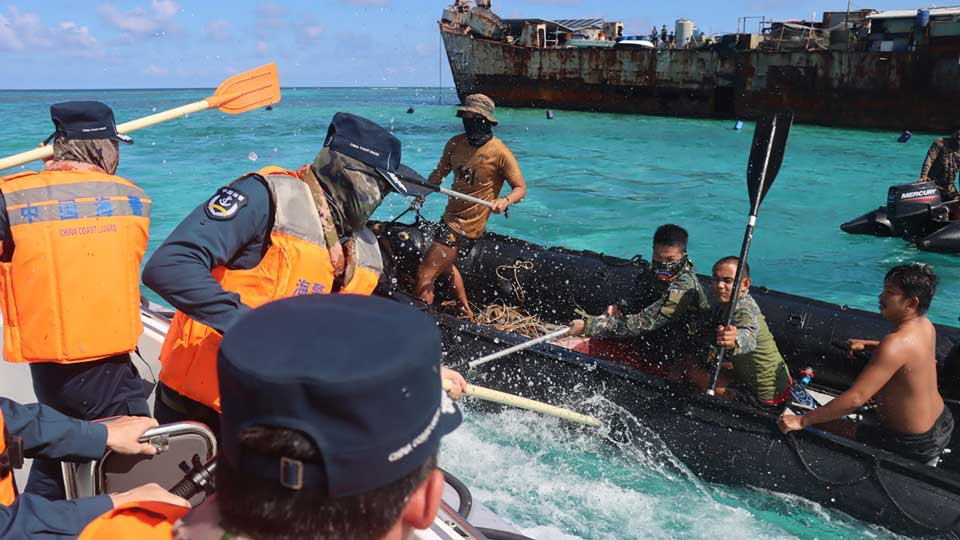
What’s going on now: According to the Philippine military, a China Coast Guard cutter approached the BRP Sierra Madre on Monday morning at Second Thomas Shoal and deployed a small boat carrying eight personnel, which came in close and circled while those aboard filmed and took photos. The Sierra Madre is a World War II-era ship Manila deliberately ran aground there in 1999 to serve as a territorial outpost, and it’s been manned by Filipino navy personnel ever since.
Two rigid inflatable boats launched from the Sierra Madre to wave the Chinese off, doing so “in a non-confrontational manner,” the military said, at which point “the Chinese coast guard vessel personnel reacted violently and aggressively by striking a Philippine Navy personnel on the head with a wooden baton, causing injury and damaging the navy rubber boat.” The military said it was assessing whether the sailor needed a medical evacuation.
Insane video of Chinese and Philippine navy having a stick fight near the contested Thomas Shoal. pic.twitter.com/vAJ7tHfNLS
— WarMonitor🇺🇦🇬🇧 (@WarMonitor3) July 20, 2026
China has a totally different story. The Chinese Coast Guard said two rubber boats launched from the “illegally” grounded Philippine vessel ignored repeated warnings, approached at high speed, and tried to surround and ram its patrol boat, with Philippine personnel launching “malicious attacks” on Chinese officers using oars and long sticks. In Beijing’s telling, its own officers stuck to verbal warnings, ship handling, and “corresponding countermeasures,” all while showing “maximum restraint.”
On Tuesday, China released video footage through state media that it says backs its account. It also summoned the Philippine ambassador. In a statement, China’s foreign ministry said “The Philippine side provoked the incident first, yet has turned around and made counter-accusations, distorted the facts and engaged in malicious hype.” The coast guard also said it allowed the Philippines to transfer the injured sailor by shuttle boat “out of humanitarian consideration,” monitoring the process throughout.
永远不要相信中国 🇨🇳🖕🤬
— 🇵🇭 Kapp 🇺🇸 (@PbbMarcos) July 21, 2026
NEVER EVER TRUST CHINA
The Philippines maintains a firm stance on defending its sovereign rights in Ayungin Shoal, stationing its military outpost aboard the BRP Sierra Madre. Following violent incidents—including a July 20, 2026 confrontation where…
The Philippine military pushed back, labeling China’s account “false and misleading” and insisting nobody on its side started the fight. “No act of coercion or aggression will deter us from carrying out our constitutional mandate or exercising the Philippines’ lawful rights in the West Philippine Sea,” the military said, using Manila’s name for the waters. The Department of National Defense said the episode “adds to a clear pattern of provocative and hostile behavior and further contributes to the People’s Republic of China’s deficit of trust and credibility,” and said it was preparing “measures to meet this aggression.”
This all comes as the US weighed in, with a State Department spokesperson condemning China’s “dangerous and aggressive” actions and saying that “China’s troubling pattern of provocation against lawful Philippine maritime operations undermines regional peace and stability and directly contradicts China’s repeated commitments to resolve disputes peacefully.”
Notably, the US has committed to helping deter Chinese aggression in the waterway, with support to the Philippines expanding into multi-billion-dollar security assistance programs, cutters, and basing facilities.
Related posts:
 China Warns Philippines Over “Provocative” Incidents in South China Sea Following Joint US-Japan-Philippine Military Drills
 US Criticizes China’s “Reckless” Actions After Collision with Philippine Ship in South China Sea
 US Kicks Off Large-Scale Military Exercises with the Philippines — China Pissed
 Philippines Announces Suspension of Scientific Survey in South China Sea Due to Harassment from Chinese Coastguard